Tuesday, December 2, 2014

5 Early Poems

Kitchen

Baking bread honestly
Shatters the light
By strength of grace
So that it must creep
Tenderly along the walls
Of the morning kitchen
Brown and gold caressing
All reflecting the oh brave
Scent of fullness.
Pregnant, eternal moment
Grants quick to firm
Makes even stone
Slip like water
Under the throb and breath
Of light discordant, glorious.

#####

Summit

There is nothing at the top
but light out cold screaming
and wind torrential, the rock
that suffers nothing and avoids nothing.
We cling, conquerors!
Only the snow moves, weaving
into an abyss.
What challenge is this?

#####

The city uncorks its pigeons
Tattooing silhouette,
Impertinent and soaring
The blazing, glittering banners
Weaving improvisation
Above bones of steel.

#####

decay and criticize
the phantoms who flicker
and return to wombs of ash.
laugh and lop
at unhurried warm life
chastise the flesh
threaten the sky
make death from baby's breath
shake disaster out of ingenuity
Daily mortify. innocence
with blind whips
is handled cruelly. it's suicide
and screams look like laughs
unheard.

#####

Dream #4

The moon probes with fierce light
the childlesss woman, bare and lost
who speaks with lucid hatred,
donates chrysanthemums, and sense-
les, grins more frightfully.

Wednesday, November 5, 2014

The Pursuit of Happiness: Love

Ronald Coleman and Madeline Carroll in "The Prisoner of Zenda" -- the romantic paradigm.
Love, o love is sweetly flowing
On its banks are lilies growing
And the waters all bestowing
Love, love, beautiful love.

Come ye children, sweetly gather
Learn to bless and love each other
It will bind your hearts together in
Love, love, beautiful love.

 Shaker song

First of all, this not about filial or fraternal love. This is about the love you sign up for.

I had planned this to be to be a rollicking survey of my romantic relationships. After a short time, it became clear that would be sad, painful, and embarrassing. I have been a romantic fool.

In fact, if I look at it from a crazy, non-constructive way, my every romantic relationship up to the present one has been a failure. Which is how I looked at it. And, what’s even less helpful, the details of these failures are mostly locked away inside me. I learned little over a remarkably long period of time with a number of different beloveds.

I know nothing about women. Ask around. Particularly women. My conceptions of love were formed by poets and paper-heart makers, Hollywood and Tin Pan Alley. As far as I can tell, my ancestors felt brief urges of passion, mated, and then settled down into monochrome normality. (After they died, I found out about their deeply repressed, tragic emotional lives. Still waters, etc.) The particular example my parents set was not particularly comforting or helpful. As a kid, when I thought at all about girls I cued on love songs, romance films, and storybook endings. The peculiar cultural window I looked through made me model myself much more on Ronald Coleman than Peter Fonda. You can guess the results.

When I began grappling with the opposite sex (fortunately, at 15 I was 6’3” and weighed 150 lbs., which made it easy to fight off my advances), bliss and disaster alternated. My first love played the alto sax, which probably says a lot about my devotion to Art Pepper. She loved marshmallow crème, laughed at my jokes, and was a great kisser.

But I began a long tradition of finding someone who could bear the extravagant weight of my urgent, undeveloped, and unmitigated emotional demands. I was scrawny and needy, and socially retarded. No one could more theatrically misinterpret reality than I could, and still can. I could perform love, I could act the swain. I wrote poems, sang songs, acted like a clown, ached, fought, made love, burned with despair. But I still hadn’t a clue.

In addition, be narcissistic and bipolar impairs selection skills. For years I found myself involved with women who were dangerously unstable, coldly remote, or simply baffled and increasingly enraged by the gap between my occasionally charming initial self-presentation and the swamp of dysfunction I would unleash as soon as she relaxed. After which I would stagger away from the burning crash site, wondering what went wrong.

Wanting is a kind of thirst that is satisfied only shortly. In my case, it has been largely poisonous. Desire is theft. Love is music. And I can barely tell them apart. What’s love, then? Would true love prevail?

Approaching the 20-year mark of my (so far) successful second marriage – successful denoting purely that it is still in effect – I can say that I am just grateful I haven’t been beaten to death in my sleep yet. (A displaced paramour once pulled a gun on me, a unique and refreshing experience I wouldn’t recommend to anyone.)

After many years, it finally is what it is. Little is like we thought it might be, and we are very different than we imagined we might be. Life has ground away at us, revealing ourselves to each other as completely as two people can. We have seen the best and the worst of each other, and I think that if you can do that and not flinch, and keep looking into the other’s eyes, you have something.

Real love is forged by the demands of necessity. Real love mysteriously accrues as the years are lived together. It’s no musical, no slow-motion gambol at waves' edge. You have to be damn stubborn and endure.

At the same time, I am learning to let go of how I think things should be between us, of creating some kind of static template of relationship satisfaction. Developing, despite myself, some compassion.

And humility. Another annoying problem is that someone that close to you can call you on your shit. Every time. There’s no place to hide. And so, by dint of the constant erosion caused by being wrong, only over the course of the last decade have I learned that I may actually BE wrong at times and, even worse, that my wife is right. And of course, once one person might be right . . . you can probably see how trying this has all been for her, she’s explained it to me a thousand times.

Love is a verb that must be incessantly acted upon, never shifting from present to past tense. Infatuations just happen. Love is a job, and its own reward. The tiny pleasures and hard-won satisfactions of each day are the rewards of working together to create a life and a home together.

When I keep my head down and keep pushing through, somehow it works. It’s a closeness and peace that flares up protectingly when times are tough. It can’t be erased or taken from. It’s knowing who I can count on, and finally accepting that I can be counted on, too. Maybe that’s what love really is for me – knowing that I am capable of transcending my own selfishness and stupidity, at least with my single someone, at least some of the time.

Love isn’t a condition. It’s an action. It’s maddening, it’s complex, it’s contradictory, it’s earned.

Next time: Work

Tuesday, October 7, 2014

CULTURAMA: 12 great French composers

I don’t despise the French,

Allow me to apologize. I know it’s pretty standard to hate them. They’ve always been good to me, though – very tolerant of my gangster-film French and American enthusiasm.

I particularly love their classical music. Normally I don’t ascribe to the virtue of one nation’s culture over another, but something about their music is special. Maybe it’s the dynamic tension between the huge cultural institutions and oversight France produces, and the counterbalancing impulse not only to rebel against conventions, but to disregard them entirely. Keeps things fresh.

Sometimes this combination of gutsiness and playfulness can backfire, leading to thin, arch work that doesn’t resonate. Still, the batting average is pretty damn good, and the dozen listed here are consistently rewarding to hear.

Here’s a subjective list of my 12 favorites. Please note that there are many that almost made it, and are certainly worth listening to – Halevy, de Machaut, Delerue, Auric, des Prez, and more. I am counting out Chopin and Stravinsky – each has typed himself unmistakably as a son of his country of origin. AND there are many French composers that drive me NUTS – Gounod, Massenet, Rameau, Lalo, Lully, Ravel, Boulez . . .

So here we go.

Marin Marais (1656-1728)


Master of the viola de gamba, he was not afraid of complexity and dissonance, and created conceptual pieces such as “Le Labyrinthe,” “La Gamme,” and the “Tableau de l’Operation de la Taille.” A busy guy, he had 19 children. His life was horribly misrepresented in the film “Tout les Matins du Monde.”

QUALIFYING ANECDOTE: He hid under his mentor Sainte-Colombe’s special practice treehouse in order to steal his bowing moves. The little sneak.

SUGGESTED LISTENING:

Sonnerie de St-Genevieve du Mont-de-Paris
Suite from “Alcyone”
Le Labyrinthe


Francois Couperin (1668-1733)


Called Couperin le Grand to distinguish him from his musical relatives. It’s unknown whether this bothered them tremendously. An adventurous keyboardist who fused French and Italian styles and who vastly extended the expressive quality of the harpsichord. His work inspired Bach, Brahms, Richard Strauss, and Ravel.

QUALIFYING ANECDOTE: To sell some of his early sonatas, he packaged them under a fake Italian name – Italian composition was all the rage and a French composer of the time couldn’t get arrested. They were wildly successful.

SUGGESTED LISTENING:

Pieces de clavecin
Two Mass settings for organ
Motets


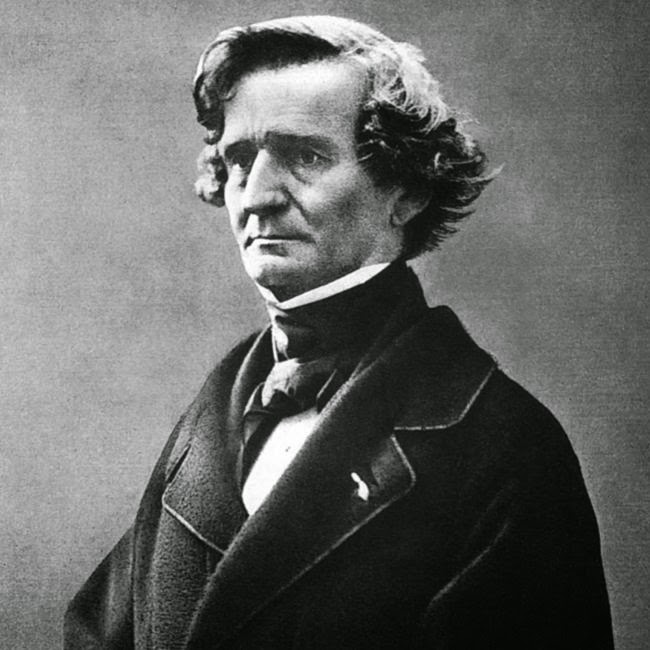
Hector Berlioz (1803-1869)


For some reason, most classical music lovers refer to the “three B’s” – Bach, Beethoven, and Brahms. What about Berlioz? He was the first French Romantic. He invented modern orchestration (his ideal orchestra was 467 strong and included 30 pianos, 30 harps, and 12 cymbals); he was a masterful conductor; incredibly literate, a devotee of Virgil, Goethe, and Shakespeare, his criticism and memoirs are still instructive and enjoyable.

But somehow he squeezed “Symphonie Fantastique,” “Harold en Italie,” the song cycle “Les nuits d’ete,” “Messe solennelle,” “L’enfance du Christ,” “La damnation de Faust,” and the magnificent grand opera “Les Troyens” – the last so grand that it wasn’t performed uncut until 147 after its composition.

QUALIFYING ANECDOTE: Always falling in love, he basically stalked his first wife, actress Harriet Smithson, for years until she gave in. It didn’t work out. He planned to murder a fiancée that rejected him. Five years before he died, he wrote: “My contempt for the folly and baseness of mankind, my hatred of its atrocious cruelty, have never been so intense. And I say hourly to Death: ‘When you will.’ Why does he delay?” Not a happy guy.

SUGGESTED LISTENING:

Les Troyens
Symphonie Fantastique
Requiem


Jacques Offenbach (1819-1880)

The funniest of all classical composers, Offenbach could mock anything and get away with it. He composed more than 100 comic works; his final work, “Les contes d’Hoffman,” was decidedly serious but still delightful.

SUGGESTED LISTENING:

Orphee aux enfers
Le belle Helene
Les contes d’Hoffman


Georges Bizet (1838-1875)


“Carmen.” That’s all you need to know. The birth of real passion and verismo in opera with an unforgettable and complex central figure.

SUGGESTED LISTENING:

Carmen
Jeux d’enfants
Symphony in C


Gabriel Faure (1845-1924)


Although he is better-known for his somewhat fluffy “Requiem” and “Pelleas et Melisande,” his piano pieces are fascinating, as are his songs, and chamber pieces. His work is clear, unified, as graceful as falling water. He was a marvel at the organ, but despised it, and left behind no compositions for it.

QUALIFYING ANECDOTE: He lost a job at a regional church as its organist when he showed up to play for Sunday mass still in his evening clothes from the night before, having never gone to bed.

SUGGESTED LISTENING:

Chanson d’Eve
Piano Trio
Works for solo piano


Claude Debussy (1862-1918)


“For better or worse Claude Debussy must be seen as perhaps the most influential figure in twentieth-century music.” – David Mason Greene. His ears, perched on his bumpy oversized head could hear what others could not, and got it down on paper.

QUALIFYING ANECDOTES: He was, according to Mary Garden, who originated the role of Melisande in “Pelias et Melisande,” a “very, very strange person.” His funeral procession moved through the abandoned streets of Paris during a German bombardment of World War I. He was played, oddly enough, by Oliver Reed in Ken Russell’s fanciful documentary “The Debussy Film.” His wife had previously been Faure’s mistress.

SUGGESTED LISTENING:

Images for orchestra
Etudes for piano
La Mer
  

Erik Satie (1866-1925)


A free spirit, he is still ahead of his time. His work, embossed with absurd titles such as “Cold Dreaming,” “Four Flabby Preludes,” and “Desiccated Embryos” was alternately brilliant deconstructions of staid musical forms, and new, unbound work that didn’t obey harmony, rhythmic pattern, or any other musical norm. Ravishingly beautiful.

QUALIFYING ANECDOTES: He purchased 12 identical gray corduroy suits, and simply rotated through them day after day. He made sketches of imaginary buildings and kept them in a filing cabinet. Some of his best compositions were found and published after his death – they had fallen behind the back of his piano and Darius Milhaud found them there after Satie’s death.

SUGGESTED LISTENING:

Works for piano
Socrate
Parade


Joseph Canteloube (1879-1957)


Like many of the nationalist composers of his time – Bartok, Janacek, Kodaly, Dvorak, and Smetana – Canteloube was a much a musicologist as a composer, traveling and researching regional, vernacular music with vigor. His “Songs from the Auvergne” took nearly 30 years to compile and complete.

SUGGESTED LISTENING:

Chants d’Auvergne


Nadia Boulanger (1887-1979)


One of the most knowledgeable, conductors, and teachers in history, Boulanger was an incredibly gifted interpreter of music. She trained, among others, Copland, Glass, Gardiner, Quincy Jones, Carter, Barenboim, and Piazzola. In her own right, her delicate songs and chamber pieces are wonderful – and unjustly overlooked.

SUGGESTED LISTENING:

Songs
3 Pieces for Cello and Piano
Fantasy for piano and orchestra


Francis Poulenc (1899-1963)


Absolutely true to himself, Poulenc could write both the most absurd and transgressive works (“Les mamelles de Tiresias,” in English “The Tits of Tiresias,” after Apollinaire, whom Poulenc met shortly before the latter’s war-wound-related death) and the most movingly spiritual (“The Dialogues of the Carmelites,” “Litanies a la vierge noire”). “I wanted music to be clear, healthy, and robust,” he wrote.

SUGGESTED LISTENING:

The Dialogues of the Carmelites
Les mamelles de Tiresias
Songs


Olivier Messiaen (1908-1992)


Still far ahead of us. His slippery, spiky, otherworldly journeys can drive you mad, but if you sit down and push through them, the listening will reward you. He could and did absorb Western and non-Western styles; like a sculptor, he subordinated the elements he needed and used them to create a singular voice. He was a masterful organist. His study of birds led to many of his most striking compositions, such as “Oiseaux Exotiques” and “Catalogue d’oiseaux.” He was imbued with a profound sense of God, and this intense spirituality permeated his meditations, such as his “Concert for the End of Time,” his nature studies such as “From the Canyon to the Stars,” and opera and oratorio such as his epic “Saint Francoise d’Assise.” He said, “I want to write music that is an act of faith, a music that is about everything without ceasing to be about God.”

SUGGESTED LISTENING:

Catalogue d’oiseaux
Des Canyons aux etoiles . . .
Saint-Francois d’Assise


Tuesday, September 30, 2014

CULTURAMA: "Much Ado About Nothing" at the Colorado Shakespeare Festival: Perfect fools

Comedy is hard. Shakespeare is hard. Therefore, Shakespearean comedy carries the highest degree of difficulty possible, for performers and audience members alike.

Luckily, Shakespeare’s comedies are, by and large, actually funny. It takes an astute director and ensemble to flesh out the promise of those gags and the real feelings couched in that antiquated language. The Colorado Shakespeare Festival’s production of the romantic comedy “Much Ado About Nothing” is blessed with that – and it’s triumphantly hilarious, one of the best shows they’ve staged in recent memory.

This show will cure anyone with Shakespeare-itis. You know if you’re afflicted – your eyes begin to roll back into your head when you hear iambic pentameter, doublets and hose give you the conniptions, and you fall into a narcoleptic coma well before the end of Act V.

Well, there are reasons the Bard is the Bard. He knows how to tell a story, he knows how to write dialogue, his characters are lively and intense. No amount of horrible English classes or other forced indoctrinations to his work will change that.

At CSF, everyone from director Lynne Collins down to the humblest supernumerary is focused on the same thing – making us laugh. They succeed splendidly. Collins has set her ensemble free: free to find the funny and work it. The dreaded Shakespearean language barrier is vaporized; you can follow the action with the same kind of relaxed clarity the players being to their performances.

The production is set in summery Spain in the mid-1930’s, a time when liberalism and conservative values warred bloodlessly, until the region tipped into civil war at the end of the decade. The warm, bright colors of Andrea Bechert’s attractive, straightforward set, anchored around a functional fountain in its center, give the proceedings a cartoonish flush.

The gist of the matter is love lost, found and confused. Geoff Kent and Karen Slack are perfectly matched as the witty, warring Benedick and Beatrice, two madcap personalities who are tricked into revealing their true feelings for each other. Neither is afraid to bend the play’s language, play with its rhythm, bring the audience into their confidence, or break up a speech with an apt bit of business or touch of physical comedy.

The play’s second, “serious” couple, Hero and Claudio are equally well-drawn by Caitlin Wise and Ben Bonenfant. The paterfamilias of the piece, Leonato, is played so adeptly and with such gravitas by Sam Gregory that he seems to gather the moral focus of the piece. Whether the trickster or the tricked as the plot demands, he radiates authority and emotion in clear and ringing tones.

Steven Patterson is just great as Don Pedro, the brother-in-arms of Benedick and Claudio. His rough-hewn, teasing soldier’s wit is pitched perfectly. The biggest surprise of the night is Michael Kane. He begins the evening as the peevish villain of the piece, Don John (his agonized melancholy is a great choice for the character) and then reappears, unrecognizably, as the affable, demented and stooped constabulary sidekick, Verges.

His crime-fighting partner is Chip Persons, as wonderfully daft a Dogberry as I can remember seeing. Clad in beret, luxuriant mustachios, and crossed bandoliers, he murders the language and the crowd with his stylized gestures and blissful ignorance.

It takes great diligence to strip away the layers of scholarship, and the intimidating reputation of Shakespeare, to get to the essence of his work and make a compelling show out of it. “Much Ado” does. Anyone who needs a laugh should snap up tickets for this show as soon as possible.

"Hell's Hinges"

This analysis first appeared in Senses of Cinema in June of 2005.

Hell’s Hinges
(1916, 64 min.)
Directed by: Charles Swickard, (William S. Hart, Clifford Smith)
Written by: C. Gardner Sullivan
Produced by: Thomas H. Ince
Cinematography: Joseph H. August

It seems highly unlikely now that William S. Hart could ever have achieved the iconic status he possesses in cinema culture. Even during his heyday, he was viewed by some critics and moviegoers as stolid, horse-faced, with an emotional disposition of slight but disquieting constipation (1).
However, an aggregation of personal qualities and external circumstances propelled him to the forefront of the national consciousness. In 68 films created over a mere 11-year span (1914-1925), he crafted an authoritative and compelling archetype, and created a moral/mythic context for film Westerns that still defines the genre today.
“Hell’s Hinges” is his most emblematic film, one whose simple power and apposite impulses transcends its most egregious clichés. It is at once reactionary and revolutionary, a film in which deeply felt piety gives its bearer license to unleash Armageddon – an emblematic American gesture that would find its way into other genres, and even invade the historical realm.
Like many who upheld the mythos of America’s Old West, Hart was an Easterner. He was born in Newburgh, New York, in 1864. His father was an itinerant miller, and his impoverished family traveled widely during his childhood. Some of this time was spent in the West and Midwest, at the tail end of the frontier period.
Though it is likely that his contact with this rapidly vanishing culture was glancing and superficial, the shy, daydreaming youth later inflated these memories, beefing them up into a recalled childhood that teemed with intimate contacts with Indians and famous frontiersmen. Hart would parlay this sense of anointment into a weighty sense of self-importance and authenticity in his work.
Hart spent nearly 25 years on American stages, working himself up into the leading ranks of Broadway performers. Adept at Shakespeare, he made his name as the original Messala in the first theatrical version of “Ben-Hur”. Then, in 1905, he filled his first Western role – that of the villainous Cash Hawkins in a production of “The Squaw Man.” From then on, “audiences … associated him with cowboy characters.”(2)
In 1913, Hart was on tour in Cleveland, Ohio, when he saw his first Western film. “It was awful! … I was an actor and I knew the West … The opportunity that I had been waiting for years to come was knocking at my door.”(3) Within a year, Hart set out for California and the movie business.
By the time “Hell’s Hinges” was made, Hart had appeared in 25 films, and captured the audience’s imagination, becoming one of film’s first genuine stars. In this, he was fortunate to fall in with pioneer film producer, and former fellow thespian, Thomas H. Ince, who applied the techniques of Ford’s assembly line to the nascent movie industry, cranking out a massive amount of product in an efficient manner – presaging the Hollywood system (4).
Given his head (and grossly underpaid) by Ince, Hart brought new qualities to the Western, which previously had been known best for chases, scenes of gunplay, and the broad emotionalism of actors such as “Broncho Billy” Anderson (another New Yorker, nee Max Aronson). Although the theme of the bad man achieving redemption through sacrifice was not unknown in the Western, Hart’s restrained gravity on screen gave new weight to as-yet-uncliched figure of the domesticated outlaw.
Hart’s subdued intensity was a marked change from the over-the-top histrionics of his predecessors. His practiced skill at manipulating an audience was honed through his incessant film work. Though his hamminess breaks through at times, the essential, “manly” stillness of his screen persona would be imitated by countless followers – most notably John Wayne.
Hart’s performances were also imbued with the sentiments of the Victorian era – giving a strangely stilted, almost Puritanical bent to even his most vicious characters. In the Hart universe, women are either catspaws of evil or vessels of light, to be spurned or worshipped. Children are devices to rouse pity and inspire sacrifice. In “Hell’s Hinges,” the simple cowboy film becomes a vehicle for an epic confrontation between good and evil.
The actions of men, or their tragic inability to act, dominate here. “Hinges” opens with the depiction of an anti-hero in unique garb – that of a minister. “Bob” Henley (Jack Standing), seen preaching to an assembly of adoring women, is characterized in the film’s intertitles as a mother-dominated, “weak and selfish youth.”
His superiors see seem as unable to stand up to the harsh demands of a city parish, and decide to send him West, “where the people live simply and close to God.” This is in keeping with the common cultural assumption of the time that the West was a more “real,” elemental place, simpler yet more challenging, a place where Darwinian processes could work themselves out unhindered. (Henley, told of this decision, fantasizes briefly about ministering to some lovely, flirtatious senoritas.)
Accompanied by his not-so-subtly-named sister Faith (Clara Williams), Henley finds himself in, not Hell, but a remarkable facsimile thereof. (The brother/sister relationship eerily echoes Hart’s own life. Frequently engaged, briefly married, he spent most of his life with his sister Mary Ellen, who jealously tended him. (5)) An introductory gunfight, taken in an overhead long shot, emphasizes the chaotic, antlike scurrying of the town’s inhabitants.
As was common in the Old West, Placer Centre – better known as Hell’s Hinges – is dominated by the pleasure palace of Silk Miller (Alfred Hollingsworth), who is characterized with casual racism as part Mexican, part snake. As the town’s Mephistopheles, he will bring all his evil talents to bear on destroying Christianity and its followers.
Hart is Miller’s confederate Blaze Tracey, who is indicated as wicked mainly by smoking, drinking, and grinning. (He shoots up a tin can that’s been decorated with a caricature of the new preacher – a nice metaphor for the relative flimsiness of Henley’s character.)
Tracey’s resolve to run the preacher out of town is stymied by his instant attraction to Faith. His poleaxed gaze at her is accompanied by the intertitle: “One who is evil, looking for the first time on that which is good.” At that point, the film’s double set of parallel actions kicks into gear. Henley’s fall is inevitable, as is Tracey’s rise and redemption. Later, in contrast to Henley’s salacious earlier fantasy, Tracey has a vision of the proverbial old rugged cross.
Like a war campaign, the town’s two sides invade each others’ territories. Miller’s soused and rowdy patrons swarm into the barn in which the town’s churchly folk, the “petticoat brigade,” hold their first service – until Tracey forces them out at gunpoint. Later, when Henley is seduced by Miller’s Dolly (Louise Glaum), the church folk, led by Tracey, march into Miller’s saloon as a body and retrieve their fallen shepherd. (One of the strongest shots in the picture is an angled shot that of Tracey marching down the main street toward the camera with the unconscious Henley draped over his shoulders.)
The spiritual coterie builds its church, with Tracey’s help – his conversion process is punctuated by a simple, affecting scene of him reading the Bible, cigarette in one hand, bottle of whiskey at his side. Ironically, Henley’s turn to drink renders him a near-imbecile, and when the town rowdies shout, “To hell with the church! Let’s burn her down!”, Henley gleefully snatches up a torch and leads the way.
A pitched battle results in Henley’s death, the expulsion of the faithful, and the immolation of the church – in one of the film’s many powerful images, Faith weeps over her brother’s corpse in the foreground, while behind, smoke boils and hurtles, wind-whipped, from the isolated figure of the burning house of worship.
The final sequence is undoubtedly what propelled the film to eventual inclusion on America’s prestigious National Film Registry in 1994. “Killin’ mad, and with a gun in each hand,” Tracey, who’s been conveniently out of town during the battle, hears of its outcome from a ragged band of refugees (what happens to the expelled “petticoat brigade”? we are never informed) returns to settle the score.
His extermination of Miller is offhand – blink and you’ll miss it. Filled with a new-found, (self) righteous vengeance, Tracey becomes a bloodthirsty, vindictive embodiment of both the “social gospel,” a popular 19th-century kind of spiritual Manifest Destiny, and its coefficient, “muscular Christianity,” which basically gave its proponents license to whip the tar out of scoffers, nonbelievers, and those of other faiths.
Rivetingly, Tracey backs the saloon’s ne’er-do-wells into a corner and shoots down the oil lamps, turning the building into an inferno (“Hell needs this town, and it’s goin’ back, and goin’ damn quick!”) Shooting down those who try to bolt, he holds the men at gunpoint until the last possible second, then allows them to flee. Remaining behind, Tracey then seems to break focus, wandering distractedly, the flames leaping up behind him. Some judicially placed flares of combustible material to the rear give Hart a hellish nimbus. It’s almost as though his descent into violence has temporarily transformed him into a demon as well, later echoed in Eastwood’s similar climax in 1992’s “Unforgiven.”
Hart strides out of the building and into the streets, moving toward the camera robotically, a death-dealing machine, like some ur-Terminator. Cowpokes and dance-hall girls scatter amid the swirling smoke, “like vague demons in some primitive hell,” (6) as the entire town burns to the ground. There is redemption for Hart alone, and it’s savage. In a peculiar foreshadowing of the Vietnam experience, he destroys the village in order to save it.
No wonder so many claimed the director’s credit for the film – although Charles Swickard is officially credited, it is generally acknowledged that Hart directed at least most of the film, with the help of long-time assistant Clifford Smith. Ince took credit for helming the fire scenes, (7) but the extraordinary strength of the film’s compositions can probably credited to Colorado-born photographer Joe August, who shot over 40 of Hart’s films and went on to be an Oscar-winning cinematographer of such Hollywood classics as “The Informer,” Laughton’s “Hunchback of Notre Dame,” and “Gunga Din.” (8) The climactic fire sequence was shot “day for night,” although prints without the colored gels that indicate day and night scenes make this difficult to remember.
At film’s end, Tracey takes up Henley’s body, and Faith’s hand, leading her into the distance. Though there is a conventional happy ending in sight, what’s gone before has tainted it, and thrown the film’s premise out of joint. Slaughter and wholesale destruction is sanctified by religion … or is it? In this wildly popular film, the audience got to have its cake and eat it too – a dangerous addiction that would crop up, for better or worse, again and again in American cinema.

-- Brad Weismann

Brad Weismann, a cinephile and former comedian, is a journalist, arts writer and playwright who lives with his wife and children in Boulder, Colorado, USA.

1. As cited in “Shooting Cowboys and Indians,” A.B. Smith, pg. 183

2 Smith, pg. 160

3. “My Life East and West,” Hart, pgs. 198-199

4. “The Complete Films of William S. Hart,” Diane Kaiser Koszarski, pg. xv

5. “William S. Hart: Projecting the American West,” Ronald L. Davis, passim.

6. “The Western,” Fenin and Everson, pg. 91

7. “The War, the West and the Wilderness,” Kevin Brownlow, pg. 270

8. Arthur Edelson, www.theasc.com/magazine/aug04/founding/page3.html

Thursday, July 17, 2014

The Pursuit of Happiness: Belonging

Part of an ongoing series.


CAVEAT LECTOR: This story contains toxic levels of self-pity. Forewarned is forearmed.

" . . . the school would impose a discipline of speed and uniformity, and those individuals which would not or could not meet the school's requirements would be killed or lost or left behind. The overfast would be eliminated by the school as readily as the overslow, until a standard somewhere between fast and slow had been attained. Not intending a pun, we might note that our schools have to some extent the same tendency. A Harvard man, a Yale man, a Stanford man -- that is, the ideal -- is as easily recognized as a tuna, and he has, by a process of elimination, survived the tests against idiocy and brilliance. Even in physical matters the standard is maintained until it is impossible, from speech, clothing ,haircuts, posture, or state of mind, to tell one of these units of his school from another. In this connection it would be interesting to know whether the general collectivization of human society might not have the same effect. . . . The slow must be speeded up or eliminated, the fast slowed down. In a thoroughly collectivized state, mediocre efficiency might be very great, but only through the complete elimination of the swift, the clever, and the intelligent, as well as the incompetent. Truly collective man might in fact abandon his versatility."
John Steinbeck, "The Log from the Sea of Cortez"

"Home is a notion that only nations of the homeless fully appreciate and only the uprooted comprehend." -- Wallace Stegner, "Angle of Repose"

Why does the very first memory have to be of exclusion, abandonment, scorn, and isolation? Just lucky, I guess.

I must have been four years old or so. I was playing on a wide, quiet, leafy street lined with big beautiful houses, stoops, wraparound porches. This would have been Monmouth, Illinois, where my family lived for a brief time. A bunch of neighborhood kids and I were playing hide and seek. I was nominated as it, first. They ran and hid. And stayed that way.

I finished counting. I searched and searched. They were gone, I never did find out where. Or why they left me. “Olly olly oxen free!” I called over and over and over, to no effect, until I was hoarse. No kids reappeared, no adults emerged to find out what was the matter. I don’t remember the aftermath. It was a scenario that would repeat itself throughout my life.

Now, looking at my account of this little incident a half-century later, it seems ludicrous. How could such a small thing have affected me so strongly? But hurt it did, the worst kind of hurt. It was a burning, palpable, shameful, lingering kind of agony, the kind that I internalized, roasting and crackling away inside me, a living perpetually stoked hell, one that kept me awake at night, wondering what kind of atonement, what fundamental change, what pretzel shape I would have to contort myself into in order to be accepted, to life the curse.

True, I did not have a lot going for me at the time. I was four, for fuck’s sake. I was puny, with no social skills, and little common sense. I was horribly near-sighted and didn’t realize it until two grades of agony and not being able to see what was going on around me had only augmented people’s idea that I was a congenital idiot. I had a hyperactive imagination and mouth, so that when I articulated whatever was going on inside me I was stared at like I was a little nutjob, or told to shut up. Whatever I was, the message I got was that it was not OK.

It extended to my extended family. I was one of a horde of male cousins, all of whom were outgoing, well-adjusted athletic types who all grew up and became shatteringly normal. I was a creepy little twerp.

I made friends here and there, usually fellow freaks. It seems that when a kid is an outsider, he or she is tagged with a radioactive signal that kids everywhere can pick up on immediately. I was soon the pariah of any neighborhood into which I moved. I pretty much learned to duck any group of two or more kids coming down the street toward me. At school, at camp, in church, on the playground, I stuck to myself.

I bonded much more easily with grown-ups, mainly teachers, but that had its obvious limitations. By the time I was mid-way through junior high school, I was thoroughly miserable, so tense that my head was permanently skewed to one side, pulling my hair out in patches, pretty much ready to be institutionalized.

Thank God for music, and theater. We didn’t have enough money to afford instrument lessons, but I could sing, which took me out of myself and allowed me to integrate my efforts, however briefly, with a larger group in the pursuit of beauty. For the first time I was literally and figuratively in harmony with others. I took to it immediately, hard. Also, I auditioned for the lead role in “The Music Man” and somehow nailed it. I could perform. I had integrity onstage, in the spotlight. I was suddenly somehow engaging, talented, entertaining. I was hooked.

This opened a treasure box for me. Humanity wanted something to do with me. My presence was needed. I told jokes that people got, I shared feelings that friends understood, I came up with ideas that people wanted to help make tangible. I could pitch in and be welcomed. It was great. With the crazy, dysfunctional home life I endured at the time, it kept me out of the house for long hours and probably saved me.

It didn’t last. I resumed my outsider status in college. I couldn’t take the super-serious business of becoming an actor . . . seriously. I couldn’t join a group, I couldn’t network, I couldn’t do the things I needed to do to advance myself. I wandered all over New York City when not in class, on my own, toting a loaf of bread and a jar of peanut butter so that I could spend the rest on theater, galleries, museums, films . . . learning much more than was probably good for me. God takes care of idiots, which explains how I was able to hang out in places such as the Bowery, Harlem, Old Times Square, Hell’s Kitchen, and Tompkins Square at all hours of the night and not gotten my throat slit.

Looking back on it now, I can see that I was suffering a kind of slow-motion nervous breakdown. My family at home blew up, our finances went south, and I quit school, coming home to catch-as-catch-can work in menial jobs and small roles in local theater. It took trying standup comedy to lift me out of myself again and put me in another brother- and sisterhood that I could hang with. With the help of plenty of booze and pot. Until, of course, the maximal limit of my talent was reached and I was slotted into the proper designation.

Of course, hand in hand with this were the repeated attempt to go straight, as it were. Time and again, I would latch onto “regular” jobs in various organizations, looking for a stable career path, a future, trying to fit in with the little cliques and kinship groups that are a part of every workplace. No matter how hard I worked to prove myself, how violently I suppressed my natural tendencies, how badly I ingratiated, it never worked out. How come?

It seems that every group has two conditional elements: a hierarchy, and a need to be taken seriously at some level. You pay proper obeisance to the hierarchy. You reinforce everyone’s sense of identity by obtaining a place in the given constellation of relationships and inhabiting it. If you stayed stuck at the bottom rung of acceptance, so be it. You were not meant to rise, or to alter the balance. When you have fully internalized the code of that particular subgroup, you may be allowed to enter the inner circle. Or not. It’s all dependent on the needs of the group, not the individual.

The behavior patterns, attitude, language, priorities, beliefs, of any given group are codified. These must be maintained as well, or the coherence of the group is threatened. Laughter is nooooot welcome. I was doomed from the start, if you think about it. With humor as my lifelong sword and shield, the tool of dissection of stupidity and cruelty, I couldn’t resist poking holes in the flimsy schemes and structures established to maintain group identity. The impulse to martyrize myself was minimal. I just couldn’t not tell the unjustly dominant to go fuck themselves. It wasn’t a perverse impulse to be a naysayer, a rebel, an antihero. Hey, I would still sell out, given half a chance! Cheaply! Give me a call!

The groups to which I will always belong are those you can’t get thrown out of – the belligerent, the disaffected, the exiled, the strange, the scorned, the discounted, the addicted, ruffians, no-goods, cranks, eccentrics, losers. The fraternities of the terminally insolent, such as comedians, journalists, recovering addicts, and others who well good and finally don’t really give a shit what anybody from the land of consensual reality thinks.

50 years later, this meditation is still ragged and incomplete. I can still feel the pull, the urge to communicate, reach out, make contact, belong, albeit from a safer distance, behind the keyboard. For decades I’ve had the image in my head of me standing outside, looking through the window at the party inside. Tapping, tapping, tapping. Olly olly oxen free.

But there’s no inside or outside, that’s all an illusion, although it is one that hypnotizes us all, the big game that you ignore at your peril, that will keep you marginalized, unemployed, and castigated. Rules that kill.

Life, however, unmitigated wonderful real life, is what is what it is. Irreducible, it can’t be denied you, and if you open up the channels dammed by self-contempt, the waters of life flow to you and through you. Then you bloom, then you feed the sky with your beauty. Then you generate thunderheads and pour down life on the other parched souls and give them hope. The circle of green widens, and the nasty little bastards who want things their way and their way only can only hang their over the fences they built to keep you all out and jaw impotently.

Maybe I had to go through what felt like death in order to know how to live. If you don’t like your society, create your own. I have. It has two rules: don’t be a jackass, and lighten the fuck up.


Friday, July 11, 2014

Why should you go to the Colorado Shakespeare Festival?

Photo by Zachary Adams. I pulled it from Geoffrey Kent's Facebook page. Thanks guys!
By BRAD WEISMANN

Out here in the provinces, theater is an upper-middle-class affectation, or something you take your grandma to once a year -- at Christmastime. You can slag the hordes in only for some traveling Broadway fare, usually. There is a niche culture of dedicated theatergoers in the area, but anyone in the biz without a stellar and spectacularly overworked marketing department to lean on will tell you that it’s catch-as-catch-can out here. There are many quite talented practitioners here, in all departments, but for most of them it’s a hobby that has to remain its own reward.

Despite the crowings of anxious promoters, various local bureaucrats and Chamber-of-Commerce types, regional cultural mandarins, big-box cultural p.r. guys, and the like, the situation is, was, and always will be desperate. The mainstream critical/press apparatus that used to fuel interest in and dialogue about the arts has pretty much suffered the fate of the Nazis at the end of “Raiders of the Lost Ark.” Es ist ganz und gar todt!

In Boulder, you can begin to redeem this situation by going to the Colorado Shakespeare Festival. Now everyone groan, both the populists who think the fare is too highfalutin’ for today’s audiences – and all the inhabitants and supporters of smaller, edgier local companies such as the Boulder Ensemble Theatre Company, square product theatre, LOCAL Theater Company, and the ones I forgot, who may be sick and tired of the attention that does get lavished on this institutionally supported annual event.

However, there are seven reasons, two of them the same, why you should go.

1.      It’s Shakespeare. Can you do Shakespeare? No, you can’t. Few can. It’s HARD. I know, I tried. I could get through about two minutes tops before either I or the audience started laughing uncontrollably. During the big stabbing scene of “Julius Caesar.” These CSF guys can do Shakespeare, usually pretty well. It’s not community theater. It’s not dinner theater. It’s not musical comedy. It’s the not the reworkings of beloved American classics, or any other kind of crap that’s not even close to Shakespeare but that nervous admins think will put asses in the seats. It’s almost certainly going to be at least tangentially Shakespearian. The new kids running the show at CSF actually care deeply about Shakespeare and are going balls-out to do a great job. And that’s important. See #7.

2.      It’s classy. In theater, the audience is king. (OK, except in experimental theater.) Who doesn’t want to be treated like royalty? Both the indoor and outdoor venues at CSF are very nice. Yes, the seats at the Mary Ripon Outdoor Theatre are made of huge slabs of rock, BUT – they have these cute little seatbacks they hand out free, and they used to CHARGE for those. Isn’t that nice? Someone tears your ticket, they smile, they give you a program, they help you find your seat. Who does that anymore? And you can pack a picnic dinner, eat on the greensward or lawn or  in front of the theater before the show, pound some wine and beer . . . crawl into the shrubbery and burn one . . . I’m pretty sure you can pass out in the grass if you like. Just pay for your ticket first, they need the money.

3.      It’s fun. Be aware, they will not throw your Frisbee back. However, in Shakespeare actors are usually stopping every once in a while to confess their plans to you, or tell you how they feel. Sometimes they blow horns and such and run up and down the aisles. Theater is supposed to involve you. Only in the 19th century did the deadly tradition of sitting absolutely still and indicating your approval with APPLAUSE and APPLAUSE ONLY begin. Shakespeare is theater from the time when the audience and the players fed off each other. YOU CAN REACT. YOU ARE SUPPOSED TO ENJOY YOURSELVES.

4.      It’s violent. Hey, did you know that Shakespeare was the Tarentino of his time? “Titus Andronicus” makes Martin McDonagh look like Oscar Wilde. And one of the gang this year at CSF is Geoffrey Kent, aka The Fight Guy. He is the president of the Society of American Fight Directors, and he really know how to put on swordplay, mayhem, and the like, plenty of which litters “Henry IV,” which hits the CSF stage this summer. So you’ve got the whole “Game of Thrones” vibe going on. In fact, why didn’t the marketing department use that? “The original Game of Thrones.” Should be bloody . . . awesome. (To be fair, Part II, which they’ve only staging three times as opposed to eight for Part I, is a lot less bloody, more like: King Henry IV: “You’re not a good son.” Prince Hal: “Yes I am!” King Henry IV: “You want to steal my crown.” Prince Hal: “No I don’t, Dad.” King Henry IV: “Where’s my damn crown?” Prince Hal: “IT’S RIGHT HERE, DAD.” Meanwhile, Falstaff’s all like, “Ooo, I’m a cheeky bugger, I am. I’m a right old rogue!” King Henry: “You better shape up.” Prince Hal: “OK, I will.” Falstaff: “Crikey, dun’t look good for yours truly, do it?”)

5.      It’s educational. Did you know that the appreciation of Shakespeare has been ruined by more middle-school English teachers than any other factor, according to my unscientific conjecture? It’s true. The only way you are going to knock that resistance and misperception out of your head is to see the stuff, live, as God intended. In this world in which our collective cultural consciousness has shrunk to the size of a mouse’s foreskin on a subzero street corner, Shakespeare is the last bastion of something in the arts we can and should all hold as common coin. If you know something about him and his work, you mark yourself as an educated individual who cares more about the bottom line and what the score is. At the very least, it increases your chances of getting laid to a nominal degree.

6.      It’s important. You should know how to see a play. It’s the second-oldest form of entertainment. It’s the root of every other art. America will never have a repertory theater company on every block, or a symphony orchestra that has to turn down an endowment because it simply doesn’t know what to do with all that money. We will not as a nation, forego the Super Bowl to watch an especially riveting episode of “Masterpiece Theater.” Motels will never hang fascinating original paintings on the walls of their rooms (except for La Reve in Pasadena, you should really check it out). But you need to develop the capacity for taking art in and letting it make you feel and think. It takes discipline and effort. Some people think art is the pickle tray in the buffet of life. It’s not, it’s the entrée. It’s like water and air and food and shelter and warmth and love. Which leads to

7.      It’s Shakespeare. There’s a reason why he’s the Quesarito of English literature. He’s a four-tool player. He knows how to tell a story, or at least borrow some really good plots. He delineates character like no one else – you really feel like you can see clearly inside everyone on stage. Every character that’s not purely a walk-on functionary has dimension and depth, and, like real people, contains and expresses contradictions and unresolved ambiguities. He’s not afraid to go for the really big questions underneath any given issue – he’s dealing with life and death, sin, guilt, dishonor, love, loss, death, a constellation of the aspects of human existence, which means his subject matter is always relevant and never gets old. And the language, the language. There’s a reason why it seeps into everything we say and write. It’s so damn apt and compelling, so much so that it will still lift me out of myself, although I’ve heard it or read it a thousand times. It’s sheer beauty.


Every time you get a chance to experience Shakespeare done well, you get to experience the human soul in high gear. The gateway is right here in the midst of us, and we are lucky to have it. It’s called the Colorado Shakespeare Festival. You really should go.

NRR Project: Mort Sahl's 'At Sunset' (1955/1958)

NRR Project: ‘At Sunset’ Written and performed by Mort Sahl Recorded 1955; released 1958 54:36 Mort Sahl was revered as an innovativ...